By Wahid Mehrdad
Ask the people of northern Afghanistan where the gold is, and you will
hear three answers. An old man in Badakhshan will point to the
mountains. A gold-washer in Takhar will point to the river gravel. A
driver in Baghlan will name the Qara Zaghan mine. All three are right
— but each means something different by “gold.” In Badakhshan, gold
sleeps in quartz veins inside very ancient rocks. In Takhar, grains of
gold have travelled down the rivers for thousands of years and settled
in the gravel beds. And in Baghlan, gold carries the name of one
famous mine: Qara Zaghan. This article tries to answer the question
with numbers — the numbers science has actually established: how much
gold is there in these three provinces?
Takhar: River Gold, and the North’s Biggest Number
The biggest gold number in the north belongs to Takhar — not in the
mountains, but in the riverbeds. In Chah Ab district, near the border
with Tajikistan, lie four well-known placer fields: Samti, Nooraba,
Khasar and Anjir. Soviet geologists drilled them thoroughly in the
1970s and wrote down their calculations: 437 kilograms for Khasar, 210
kilograms for Nooraba and 155 kilograms for Anjir — 802 kilograms
together. Samti had its own account: the Soviet estimate for it was
close to 30 tonnes of gold, impure and mixed with gravel.
Years later, the U.S. Geological Survey measured the same ground
again, this time with satellite mapping and computer terrain models.
The new assessment reads: about 20,927 kilograms for Samti, about
7,626 kilograms for the Nooraba–Khasar–Anjir group, and roughly 1,500
kilograms in the Kocha River fields. The two studies end at nearly the
same total — about 30 tonnes — but they get there differently: the
Soviets put most of that weight on Samti, while the new assessment
credits Samti with less and the other fields with more. Beside this
river gold, Takhar also has vein gold — the Pusida vein in Warsaj
district, for example, grades between 0.1 and 1.1 grams per tonne of
rock, and up to 3 grams in its narrower zones.
Badakhshan: Vein Gold — Lightly Measured, but Everywhere
In Badakhshan the story is reversed: here the gold is in the
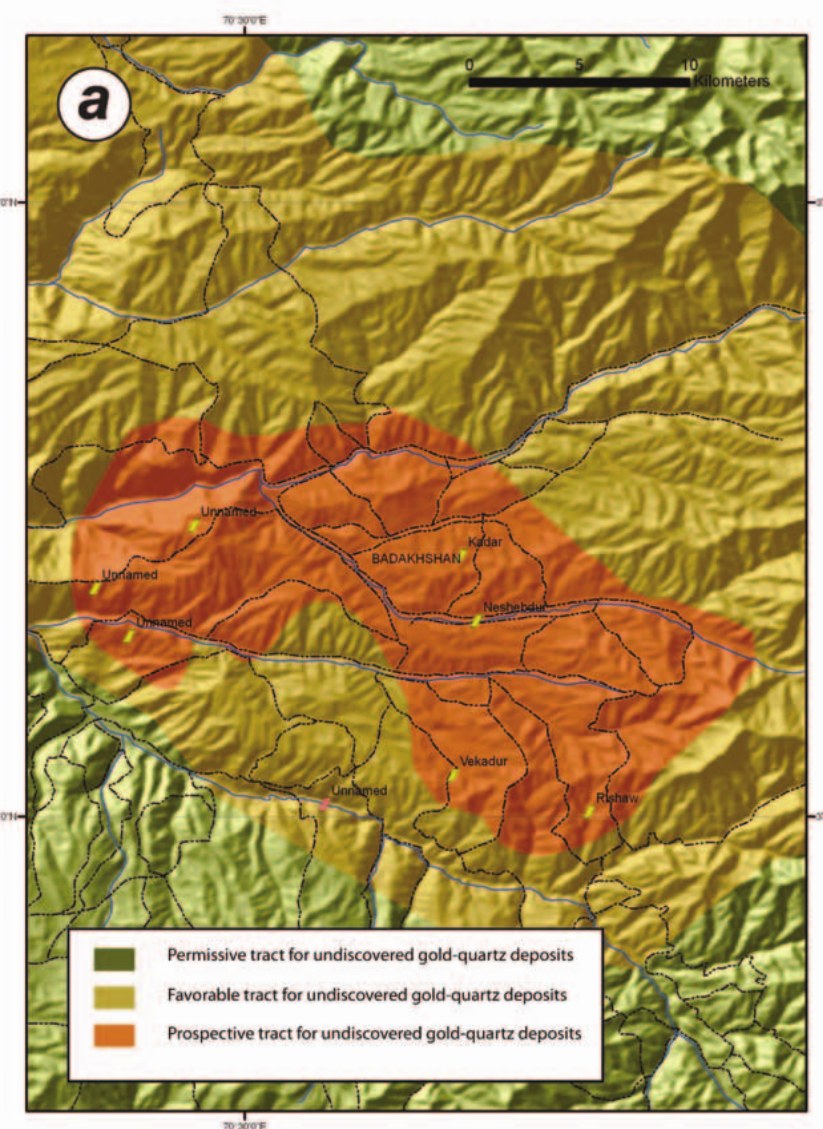
mountains, not the gravel. Its most famous address is Vekadur, in Ragh
district, one of the largest gold occurrences in the country, where
Soviet geologists in the 1960s calculated resources of 958 kilograms
of gold at an average grade of 4.1 grams per tonne — with silver
grading as high as 46.7 grams per tonne. At Chilkonshar, forty quartz
veins have been counted, four of them with commercial grades of 12.3
to 84.9 grams per tonne, and speculative resources of about 245
kilograms. Shenghan spreads gold showings over 110 square kilometres,
and Furmorah shows 3.3 grams per tonne across a mineralized area of 80
square kilometres. Other names — Kadar, Neshebdur, Rishaw, Nakhchir —
are each a vein and a promise.
Add all of these up, however, and the “measured” figure will surprise
you: in the U.S. Geological Survey’s assessment, the total measured
resource of vein gold for Badakhshan and two other provinces (Ghazni
and Zabul) together is only about 1,780 kilograms. Badakhshan’s gold,
in other words, is still more “indication” than “measured reserve”:
hundreds of veins and geochemical halos are recorded in the mountains
of Ragh, Shahri Buzurg, Darwaz and Jurm, but very few places have seen
complete drilling and measurement. Yet this lightly measured gold now
turns the wheels of thousands of households: in February 2026 the
Taliban group’s Ministry of Mines and Petroleum announced that in six
districts of Badakhshan — Shahri Buzurg, Yawan, Kohistan, Raghistan,
Khwahan and Arghanj Khwah — close to 100,000 people are employed in
gold mining directly and indirectly, and the provincial mines
department speaks of 650 to 700 registered companies. According to the
same department, the government collected 112 kilograms of gold in
Badakhshan last year alone. Traditional gold washing — zarshouyi —
alive for centuries on the Kokcha and Panj rivers, is now giving way
to excavators and companies.
Baghlan: Qara Zaghan — Famous and Unmeasured
Baghlan, in this story, is the province of a single mine: Qara Zaghan.
The mine had long been in the hands of the family of Sayed Mansur
Naderi, the Sayed of Kayan: the family had mined gold there
artisanally for generations, and his son Sadat Mansoor Naderi won its
formal licence in 2008. In 2011, when work to expand the mine began
with foreign investors and a planned investment of 50 million dollars,
Qara Zaghan became famous as the country’s second gold mine. Its
licence covers 1,257 hectares; reports of those years spoke of about
2.5 million tonnes of ore in the area, and 2,000 metres of core
drilling and sampling were carried out. But the honest point is this:
the U.S. Geological Survey wrote in those same years that Qara
Zaghan’s gold reserves were “not yet known” — and the results of that
drilling were never published. So Baghlan, unlike Takhar with its
clear number and Badakhshan with its countless indications, remains an
unanswered question: the gold is there, but nobody has documented
exactly how much.
In Closing
So if anyone asks, “How much gold is there in the north?”, the answer
is clear: about 30 tonnes of placer gold in Takhar by the newest
estimate, less than a tonne of measured vein gold at Vekadur, and a
few hundred kilograms here and there — set against a belt of gold
veins and halos stretching from Darwaz to Warsaj that has still not
been fully measured. The gold of the north, in other words, is both
real and, for now, more horizon than ready reserve.
But the more important question than “how much” is “whose”. Today
these mines, instead of supporting the lives of the people of the
north, have fallen into the hands of non-native terrorist groups and
are being plundered; gold that should have become schools, hospitals
and roads for these very people is being pulled from mountain and
river gravel with no oversight at all, while groups engaged in
smuggling minerals — most of whom have come from across the Durand
Line — quietly carry it out of the country. Local people pay the price
of this rush, too: in January 2026, clashes between residents of Chah
Ab and the contracted mining company left four people dead.
Yet these mines are the foundation on which national governments for
the natives of this region can be built; the people who have lived on
this land for generations are the true owners of this treasure.
Guarding this wealth is the duty of those same people, and one day the
hand of these groups must be cut off from it. And if this looting goes
on, in a few years nothing will be left for the local residents except
the pits and holes left behind by gold extraction: the mines will have
been stripped bare, and for the true owners of this soil only empty
craters will remain.
Leave a Reply